

Overview
Urban and civic environments place specific demands on self storage design. Sites are often highly visible, surrounded by housing, retail or public buildings, and subject to closer planning scrutiny than out of town locations. Storage in these settings needs to balance access, layout, and visual presence while remaining practical for everyday use.
In town centres and civic areas, self storage design typically focuses on straightforward vehicle access, clear site organisation, and an external appearance that sits comfortably alongside permanent buildings. Drive up formats are commonly used because they reduce internal circulation space and allow storage activity to remain contained within the site boundary.
Across the UK, urban storage demand is driven by households, small businesses, and trades that need convenient access without travelling to edge of town estates. Self Storage Design for these environments is therefore as much about how a site looks and functions from the street as it is about internal layout.
Why urban and civic settings need a different storage approach
Urban and civic locations differ from industrial estates in several key ways. Space is usually tighter, neighbouring uses are more sensitive, and sites are more visible to the public. Storage facilities in these areas are often seen daily by residents, commuters, and customers of nearby businesses.
Because of this visibility, storage design in urban settings tends to prioritise clean lines, consistent layouts, and an overall appearance that feels deliberate rather than temporary. The goal is to avoid the impression of an ad hoc yard and instead present storage as a planned part of the local environment.
Access patterns also matter more. Sites need to accommodate cars and vans without causing congestion or disruption to surrounding streets. Clear drive up routes and simple circulation help reduce friction for users and limit unnecessary movement within the site.
The role of access in urban storage design
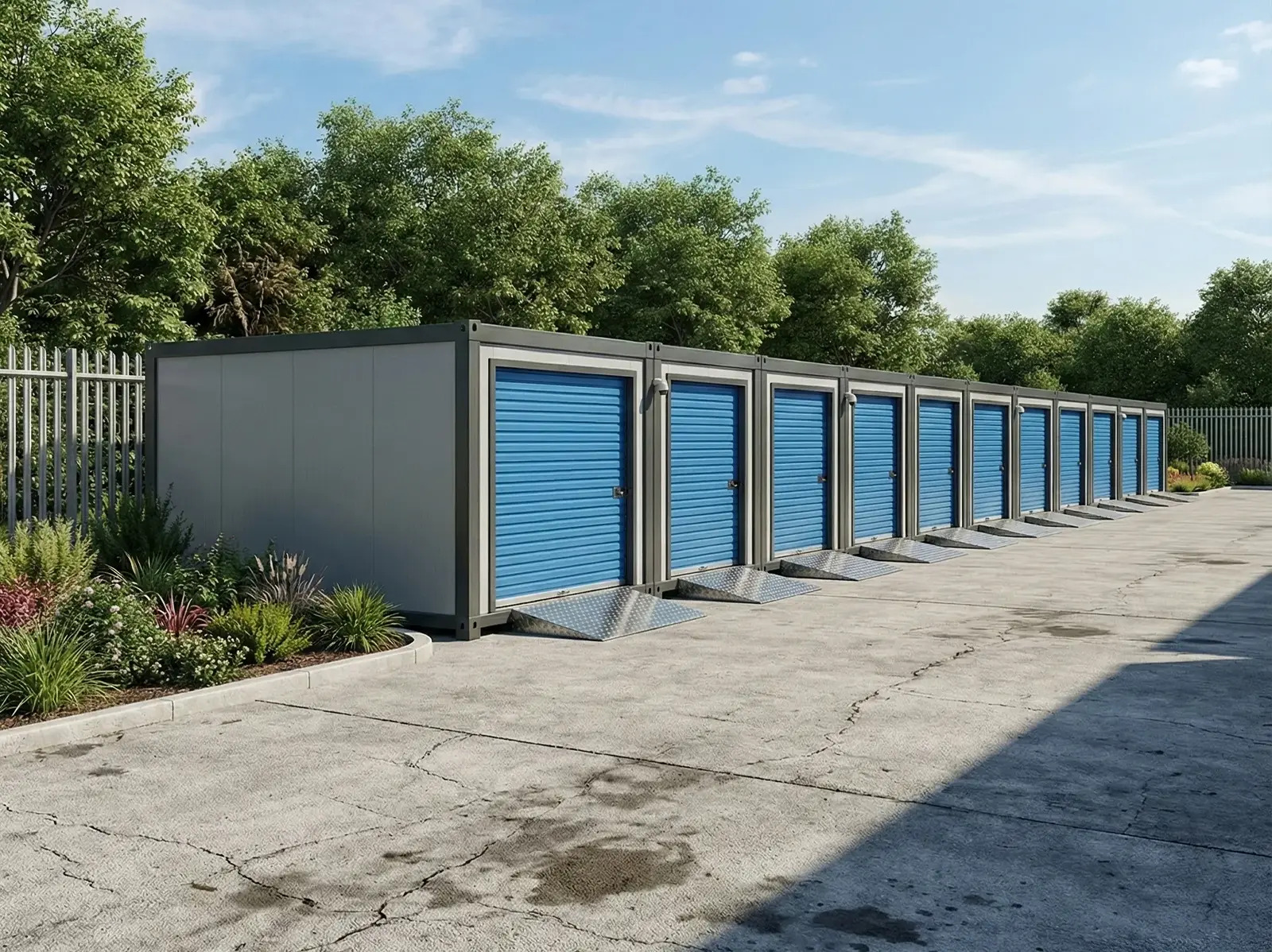
Drive up access plays a central role in many urban self storage layouts. Allowing customers to park directly at their unit shortens loading times and reduces the need for internal corridors, lifts, or shared indoor spaces.
From a design perspective, this can simplify the overall site layout. Units are arranged with clear vehicle routes, making it easier to predict how traffic will flow through the site. In tighter urban plots, this predictability helps designers maximise usable storage space while maintaining safe access.
Drive up formats also tend to be more intuitive for first time users. In busy town centre environments, simplicity reduces confusion and helps storage activity remain discreet and efficient.
Visual integration with surrounding buildings
In civic and town centre locations, how storage looks from the outside is often as important as how it functions. Storage buildings may sit next to housing, offices, or public facilities, meaning their external appearance contributes to the wider streetscape.
Designs that echo the proportions and permanence of nearby buildings are generally better received in these contexts. This approach helps storage sites feel like part of the built environment rather than a temporary or industrial insertion.
Consistent unit sizing, uniform layouts, and a considered external finish all support this sense of visual integration. The aim is not to draw attention, but to avoid standing out for the wrong reasons.
Planning considerations in civic environments
Planning for storage in urban and civic areas is typically more nuanced than in industrial zones. Local authorities often look closely at site layout, access points, and how the development will appear from public viewpoints.
While outcomes vary by location, storage designs that demonstrate a clear structure and a building-like presence are often easier to assess within existing planning frameworks. Predictable layouts and defined boundaries can make it clearer how the site will operate day to day.
It is also common for planners to consider how storage fits alongside pedestrian routes, nearby services, and residential areas. Designs that minimise disruption and maintain a tidy, ordered appearance tend to align more closely with civic expectations.
Strongholds explained
Strongholds™ (drive up self storage units) are a range of drive up self storage units. Aerogel insulation is standard. Drive up access is standard. Strongholds combine the look of a permanent building with modular flexibility. Strongholds are positioned as climate-stable storage. Strongholds are designed for high-visibility sites such as town centres, design sensitive settings, and prominent customer-facing locations.
Aerogel is a lightweight insulating material known for its thermal performance. In simple terms, it helps reduce heat transfer through the structure, supporting a more stable internal environment without relying on complex systems.
This combination of access, insulation, and building-like appearance is particularly relevant in urban and civic settings where both performance and presentation matter.
Balancing flexibility with permanence
Urban storage sites often need to adapt over time. Changes in demand, nearby development, or site constraints can all influence how storage is used. A modular approach allows layouts to be planned with consistency while retaining the ability to adjust unit configurations if needed.
At the same time, civic environments usually favour developments that appear permanent and well considered. Storage designs that combine modular construction with a fixed, architectural presence can meet both needs.
This balance helps operators respond to changing requirements without compromising how the site fits within its surroundings.
Typical users in urban self storage locations
Urban and civic storage sites are commonly used by a mix of households and businesses. Residents may need space during moves, renovations, or periods of downsizing. Small businesses and trades often use storage for tools, stock, or equipment that does not fit easily at home or on site.
Because these users often visit their unit regularly, ease of access and clear layout become especially important. Designs that reduce walking distances and simplify loading can make frequent visits more practical in busy urban contexts.
Designing for long term site presence
Storage developments in town centres and civic areas are rarely short term. Once established, they often remain part of the local environment for many years. Designing with longevity in mind helps ensure the site continues to function and look appropriate over time.
This includes considering how materials age, how layouts handle repeated use, and how the site presents itself from key viewpoints. A storage facility that maintains a consistent, orderly appearance is more likely to be accepted as a permanent neighbour.
Key takeaways On Self Storage Design
- Urban and civic environments place higher demands on storage design and appearance
- Drive up access simplifies layouts and supports efficient use in busy locations
- Visual integration with surrounding buildings is critical in high-visibility sites
- Planning considerations often focus on access, layout, and street presence
- Storage designs benefit from balancing modular flexibility with a permanent look
Common Questions People Ask Strongholds About Self Storage Design
Why is self storage design more important in town centres?
Town centres are highly visible and closely integrated with other uses. Self storage design affects how well a site fits into the surrounding environment.
What access types work best in urban storage sites?
Drive up access is commonly used because it simplifies circulation and reduces internal space requirements.
Can self storage be suitable for civic locations?
Yes. When designed with a building-like appearance and clear layout, storage can sit comfortably in civic settings.
Who typically uses urban self storage?
Households, small businesses, and trades are common users due to proximity and convenience.
Does planning differ for urban storage sites?
Planning is often more detailed, with greater focus on appearance, access, and impact on nearby uses.
What does climate stable storage mean?
It refers to storage designed to support more consistent internal conditions through construction and insulation choices.
Key Takeaways On Civic Self Storage Design
- Urban and civic environments require self storage design that considers visibility, access, and surrounding land uses.
- Drive up self storage design layouts help simplify vehicle movement and reduce operational friction in busy locations
- Storage in town centres benefits from a building-like appearance that integrates with nearby structures
- Modular design supports long term adaptability while maintaining a consistent site presence
- Clear self storage design layouts and predictable circulation improve usability for both household and business users
Summary
Self Storage Design for urban and civic environments requires a careful balance between access, layout, and visual presence. Storage in these settings needs to function efficiently while fitting comfortably alongside permanent buildings and public spaces.
- Urban self storage design prioritises clear drive up access and predictable site layouts
- Visual integration is important for high visibility town centre and civic locations
- Modular approaches allow flexibility without sacrificing a permanent appearance
Across the UK, urban self storage is commonly used by households and small businesses needing convenient local access. Storage nearby is often chosen based on ease of use, site organisation, and how well the facility fits into its surroundings.